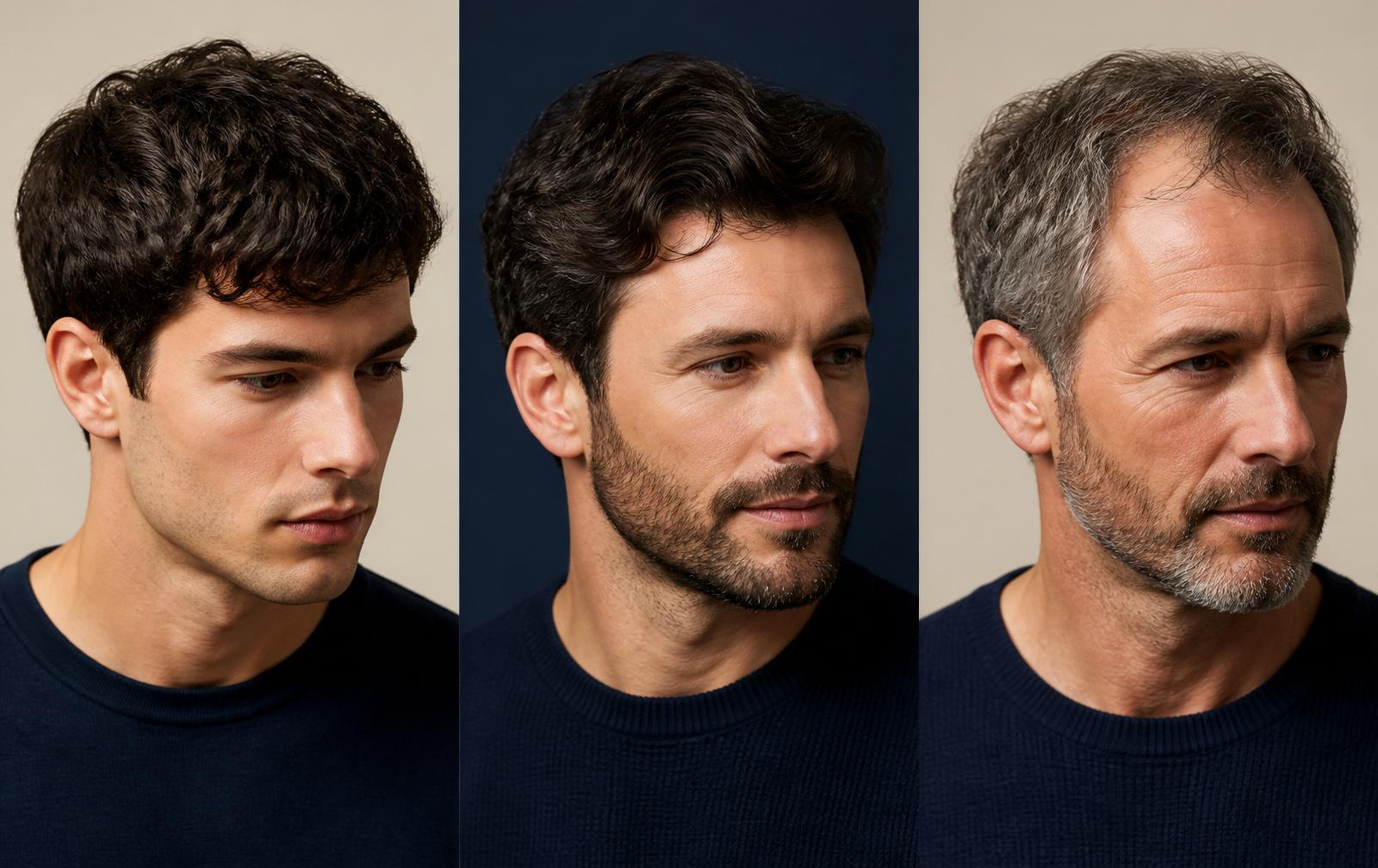
Hair Loss by Age: What Changes in Your 20s, 30s and 40s
How hair typically changes in your 20s, 30s and 40s — a calm, practical guide to the patterns, the signals worth reviewing, and the care principles that support long-term density.
Hair changes are a normal part of adult life, but the pattern, timing and speed of those changes can look very different in your 20s, 30s and 40s. Understanding what is happening at each stage — and what is worth acting on early — makes it much easier to protect long-term hair density instead of reacting once thinning has already become obvious.
This guide is a practical, non-alarming overview written for adults who want an informed picture of hair loss by decade. It does not diagnose any condition and does not replace a professional consultation.
In this guide
- The hair cycle in one minute
- Hair loss in your 20s: what is usually happening
- Hair loss in your 30s: the transition years
- Hair loss in your 40s: density, quality and maintenance
- A side-by-side comparison by age
- Signals that suggest an assessment could help
- Care principles that support scalp and hair health at every age
- Frequently asked questions
- References
The hair cycle in one minute
Every hair on the scalp moves through a growth phase, a short transition phase and a resting phase before it eventually sheds and is replaced. On a healthy scalp, this cycle repeats continuously and thousands of hairs are always in different phases at the same time. That is why some daily shedding is normal.
Long-term density depends on two things: how many follicles are actively producing hair, and how strong each strand is. When shedding stays higher than regrowth for a long period, or when new strands come in noticeably thinner than before, overall density can start to look different in photographs — even before it feels dramatic day to day.
Hair loss in your 20s: what is usually happening
In the 20s, hair usually still feels full and behaves predictably. When change appears in this decade, it tends to fall into two broad categories.
Temporary shedding episodes
Short, self-limiting shedding episodes can follow major physical or emotional changes such as prolonged stress, restrictive dieting, rapid weight change, iron or vitamin shortfalls, illness with high fever, or hormonal shifts. Shedding often becomes visible two to three months after the trigger, which is why the original cause is sometimes hard to spot.
Temporary episodes generally settle when the underlying trigger is addressed, but they can look alarming while they last.
Early pattern thinning
Gradual pattern thinning can start earlier than many people expect. In the 20s it often shows up subtly: a slowly widening middle part, a hairline that is beginning to change shape at the temples, or a ponytail that feels lighter than it used to. Family history on either side is a useful clue.
Repeated stress on the hair — very tight styles, frequent chemical processing or aggressive heat — can also amplify the appearance of early thinning.
Hair loss in your 30s: the transition years
The 30s are often when subtle changes become harder to ignore. The hair cycle is still active, but small differences that started in the 20s may now be visible in everyday photos.
Shifts in strand quality
New hairs may come in slightly thinner or shorter than before, especially at the crown or along the part. The overall density can still look full, while individual strands feel less substantial.
Life-stage stressors
Career pressure, disrupted sleep, and post-pregnancy hormonal changes can each interact with the hair cycle. Shedding related to these factors is usually temporary, but recovery often takes several months, and it may unmask a pattern that had been developing quietly underneath.
Scalp changes
The scalp itself matters. Persistent oiliness, flaking, tightness or discomfort can indicate that the scalp environment is no longer optimal for the hair cycle. Addressing scalp comfort is often a helpful first step at any age.
Hair loss in your 40s: density, quality and maintenance
By the 40s, most adults notice at least some change in hair volume, texture or shine. This is not automatic and it is not the same for everyone, but understanding what is likely helps set realistic expectations.
Gradual density change
The number of active follicles may decrease slowly, and hair diameter can become finer for many people. When combined with any earlier pattern tendency, this can lead to a visibly thinner mid-length or crown.
Recovery takes longer
Temporary shedding events in this decade can take longer to resolve than they did in the 20s. This is one reason why proactive scalp and hair care tends to become more important with age.
The role of overall health
Hormonal balance, thyroid function, sleep quality, nutrition and long-term stress all interact with the hair cycle. Reviewing general health with a qualified professional is a reasonable step for anyone who notices persistent or unusual changes in this decade.
A side-by-side comparison by age
| Age range | What tends to be typical | Common patterns to watch | General focus of care |
|---|---|---|---|
| 20s | Predictable density, steady cycle | Temporary shedding after stress, dieting or illness; very early pattern changes | Gentle daily routine, scalp comfort, addressing lifestyle triggers |
| 30s | Slight change in strand quality | Widening part, softer ponytail, post-hormonal shedding phases | Scalp assessment, sustainable routine, considered use of supportive care |
| 40s | Gradual density and texture change | Thinner mid-length or crown, longer recovery from shedding events | Long-term maintenance, general health review, professional guidance for options |
Signals that suggest an assessment could help
Not every change needs action, but the following patterns are usually worth reviewing rather than ignoring:
- Shedding that stays noticeably higher than usual for more than three months
- A part line that continues to widen from one season to the next
- A hairline that keeps changing shape over time
- New scalp discomfort, persistent flaking or itch that does not settle
- Hair that feels significantly finer than it did in comparable photos a year or two earlier
A structured consultation can help distinguish a temporary phase from a pattern that may benefit from ongoing care.
Care principles that support scalp and hair health at every age
There is no single routine that suits everyone, but a few principles apply across decades:
- Keep the scalp clean and comfortable with products that suit its condition rather than the trend of the moment
- Reduce repeated mechanical stress from very tight styles, aggressive brushing on wet hair and frequent high-heat styling
- Support overall health: balanced nutrition, adequate sleep, and reasonable stress management
- Be patient with any plan — meaningful hair changes are usually visible over months, not days
- Take standardised reference photos every few months so that decisions are based on trend, not on a single bad-hair day
Frequently asked questions
Is hair loss in your 20s always permanent?
No. Increased shedding can be related to temporary changes such as restrictive dieting, rapid weight change, prolonged stress or repeated hair damage. However, gradual pattern thinning can also begin during early adulthood. The pattern and timeline matter more than age alone.
Why can hair start shedding months after a stressful event?
The hair cycle does not always respond immediately. Temporary excessive shedding may become noticeable several weeks or months after a major physical or emotional change.
Does hair automatically become thinner after 40?
Hair density and strand thickness can change with age, but the degree and pattern vary widely. Age should be considered together with family history, scalp condition, lifestyle and the speed of change.
Should you count every hair that falls out?
Counting can provide a rough idea, but it is easy to overestimate or underestimate. Standard photographs, the width of the middle part, ponytail thickness and crown visibility may be more useful for long-term monitoring.
Can shampoo alone stop progressive thinning?
Shampoo can support scalp cleanliness and comfort, but progressive thinning often requires a broader plan. The most suitable combination depends on the individual pattern and goal.
How long should a hair-care plan be monitored?
Hair changes slowly. In many cases, consistent photographs over three to six months provide more meaningful information than daily observation.
Is PRP suitable for every age?
Age alone does not determine suitability. The current condition of the hair, scalp and follicles, the pattern of thinning and the intended goal should all be considered.
Can temporary shedding and pattern thinning occur together?
Yes. A temporary shedding episode can make an existing gradual thinning pattern appear much more noticeable.
Talk to us about your hair
References
- American Academy of Dermatology Association. Hair loss: Overview. aad.org
- National Institutes of Health, MedlinePlus. Hair loss. medlineplus.gov
- Cleveland Clinic. Hair loss. my.clevelandclinic.org
Medical disclaimer
This article is for general information only and is not medical advice. Individual results may vary. Please consult a qualified professional before starting any hair treatment, product regimen or medical procedure.
Medical disclaimer
This article is for general information only and is not medical advice. Individual results may vary. Doctor consultation is recommended before starting any treatment, supplement or procedure.